
 Professional background
Structure first – reward, if you want
Confetti and medals are fun to show, but they are not the heart of Ollie. The heart is a predictable day in pictures that the child can follow independently. Here you can read what the research says, and why you decide how much reward there should be – and whether there should be any.
Last updated 29 September 2026
In short
- The structure is the foundation. Visual plans are one of the best documented forms of support for children with autism – and they help many other children to understand and remember the day.
- Medals are optional. They are turned off until you choose them yourselves, because rewards can reduce motivation for some children.
- The celebration can be turned up and down – from a big party to a quiet tick. The Adult and Calm styles start with none at all.
- The aim is for the child to manage more on their own – with fewer reminders from the adults.
- You know your child best. Almost everything can be adapted for each child and changed as the child develops.
 A predictable day in pictures
For many children, it is hard to know what is going to happen and when. It can lead to restlessness, conflicts and lots of questions – especially in the switches from one thing to the next. A visual plan makes the day visible: The child can see what is happening now, what comes next, and when it is finished.
Visual support is one of the best documented methods for children with autism. The large American review of the research from the National Clearinghouse on Autism Evidence and Practice counts it as evidence-based practice1. Visual schedules can make children more independent and reduce challenging behaviour2,3 – also in difficult transitions4. In Danish special education, the approach is known from structured teaching, which is based partly on TEACCH5.
Predictability matters a lot, because uncertainty is a major source of anxiety for many children with autism6. But all children benefit from knowing what is going to happen. Research into families’ everyday lives suggests that fixed routines are linked to children’s wellbeing and health7.
 How we do it in Ollie
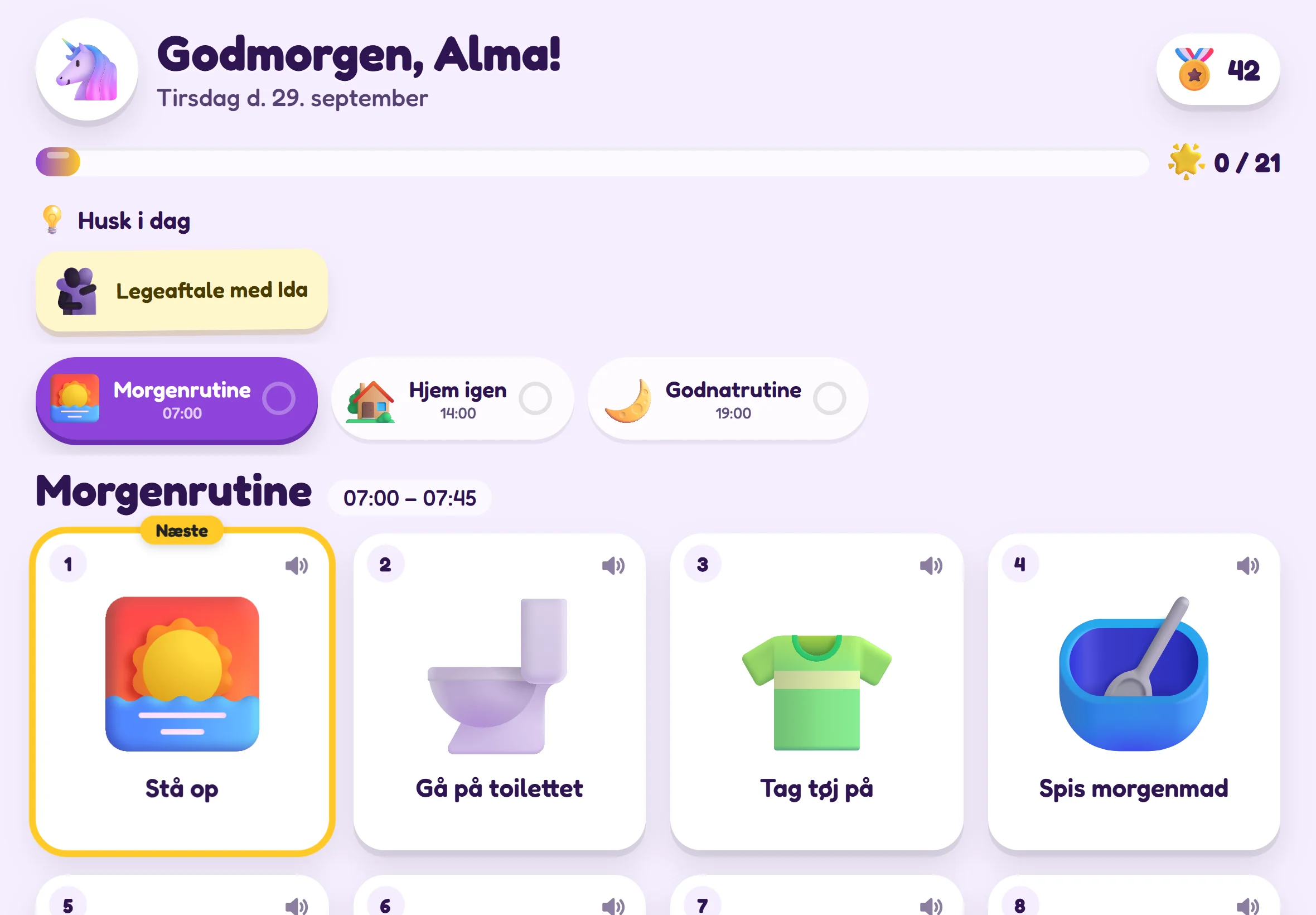
 Pictures in order. Large pictograms, and the next task is highlighted.
 The right routine at the right time. In the morning, the morning routine is shown; in the evening, the bedtime routine – all by itself.
 Remember today. Dentist, playdate and other things that are different today are at the top, so the child can prepare.
 Own photos. Some children recognise a photo of their own toothbrush more easily than a drawing8.
 Read aloud and text. The child can understand the plan, even before they can read.
 Help where the task needs to be done
Many children – and especially children with ADHD – find it hard to hold several things in their head, remember the next step and get started. It is about executive functions: working memory, impulse control and the ability to switch from one thing to another9. It is not a question of willpower.
That is why ADHD researcher Russell Barkley recommends moving the help out of the head and to the place and time where the task needs to be done10. A plan the child can see remembers for the child – so the adults do not have to.
How we do it in Ollie
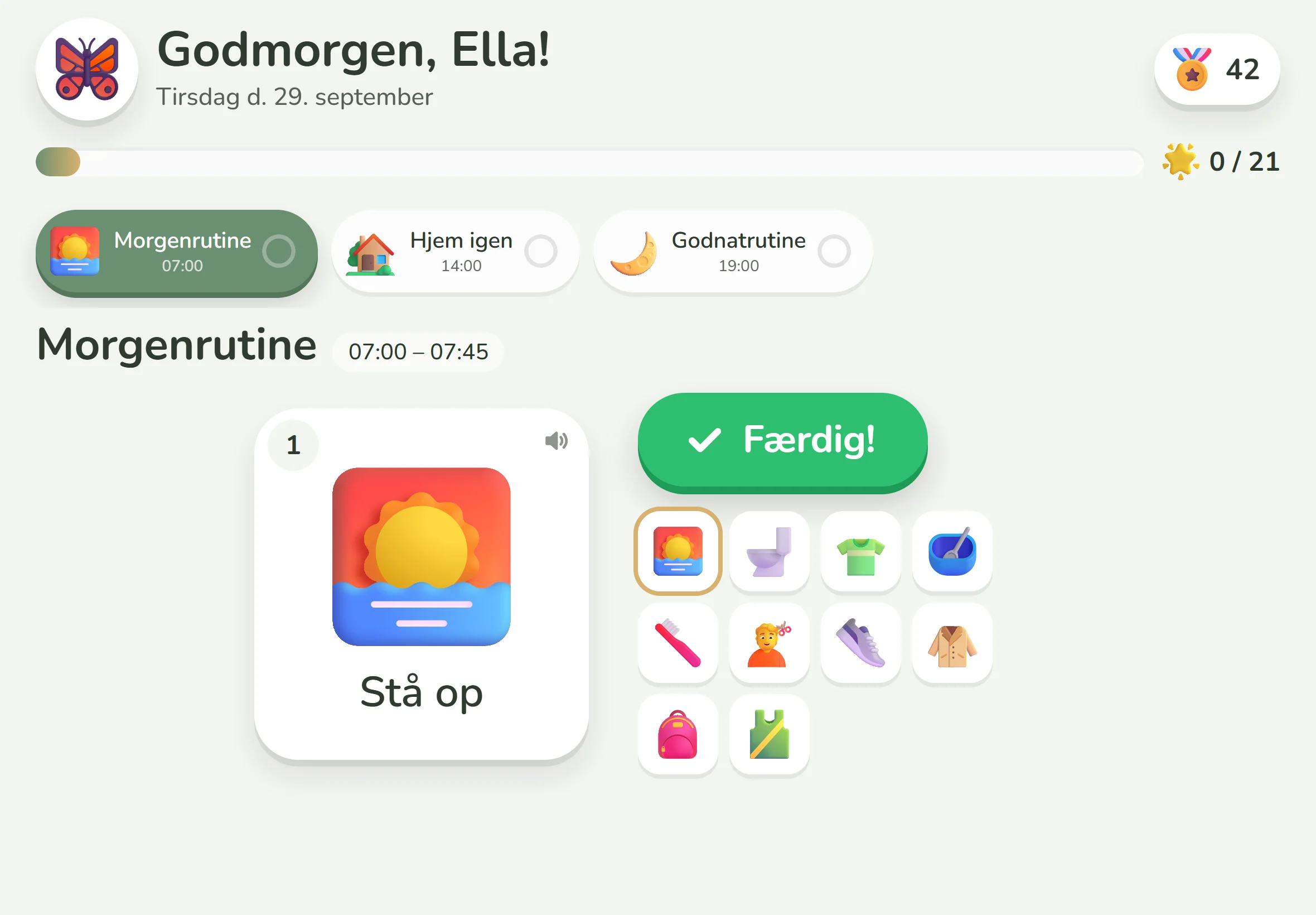
 One at a time. The view shows only the next task, large and clear – for children who are overwhelmed by a whole list.
 Follow-up tasks. When the child has ticked off the bath, the app asks whether the towel has also been hung up – right where it is easy to forget. If the child answers “Not yet”, it becomes a task of its own right after.
 Keep the screen on. The plan does not disappear in the middle of the morning routine, and the screen turns off again when the routine is done.
 Extra task today. If something special is going to happen, it is included in the plan – without changing the fixed routine.
 Reward – and why it is optional
Confetti and medals can look like the most important thing in Ollie. They are not, and that is a conscious choice.
Rewards can reduce motivation
Motivation research has shown for 50 years that rewards can crowd out the enjoyment that comes from within. In a classic experiment, kindergarten children were promised a reward for drawing. Afterwards, they drew less on their own than children who had not received anything – and than children who had been surprised with a reward11. A review of 128 experiments confirmed the pattern and found that it is strongest in children12. In economics, this is called motivation crowding: The external reward pushes out intrinsic motivation13.
But that is not the whole story
Other researchers have shown that rewards are not always harmful14, and for some children – for example many children with autism – systematic reinforcement is a well-documented method1. Rewards mainly crowd out the enjoyment that is already there. And there is not much enjoyment to crowd out when it comes to brushing teeth or packing a school bag.
With that kind of task, the goal is not for the child to love them. The goal is that the child gradually understands why they are important and does them because it makes sense – even when no one rewards it. Self-determination theory calls this internalisation15.
What matters is how the reward is experienced
If the reward is experienced as control – “you only get something if …” – it can reduce motivation. If it is experienced as a sign that you can do something, it can increase motivation12,16. Praise works best when it is sincere, does not compare the child with others and shows that the goal is within reach16.
How we do it in Ollie
 Medals are turned off until you choose them. In the setup guide and under Children, you can read about the advantages and disadvantages and choose for each child.
 The celebration can be turned up and down – from a big party to a quiet tick – and the sounds can be turned off.
 Progress without a prize. The child can always see how far they have got today. It is information – not payment.
 Praise the effort. The app praises what the child does – “Great work!” and “You kept going until everything was done!” – not who the child is16.
 No comparison. The child only sees their own plan, never their siblings’.
 No minus points. Nothing is ever taken away. If the child taps by mistake, the tick can be undone, and a medal that was earned by mistake disappears again.
You decide how much happens
- Ticks onlyA tick and a short message.Grown-up and Calm
 Small partyA little confetti and short celebrations.Young
- Big partyConfetti at every tick and big celebrations.Playful
 + MedalsFor tasks, perfect days and days in a row.Always optional
The labels show where each style starts. Celebration, confetti and sounds can be changed for each child.
A good place to start
If you are unsure, start without medals and with a little celebration. If you use rewards to get a new habit started, turn them down again once the habit is in place – from big party to small party to just the tick. And talk with the child about why the task is important. That is what makes the habit last when the confetti is gone.
Signs that it is time to turn it down: The child asks “what do I get?”, only does the tasks for the medals, or gets upset when a streak of consecutive days is broken.
 The child does it themselves
Children thrive and learn best when they experience that they have influence, that they can do things, and that they belong. This is the core of self-determination theory15. When parents support the child’s independence rather than controlling them, it is linked to the child becoming better at self-regulation17,18, and even small choices can increase motivation for a task19.
A visual plan also moves the reminders away from the adults. When the plan shows what comes next, the adult does not need to say it – and the morning becomes less a series of messages and more something the child manages on their own. That is exactly the purpose of visual schedules: for the child to become less dependent on reminders from adults20.
How we do it in Ollie
- The child ticks off tasks themselves. It is the child’s plan – not a checklist for the adults.
 The child can choose the order. If you turn off “Show order”, the child chooses what to do first. The order is a help, not a requirement.
 The child’s own plan. Choose character, colours and background together with the child – or use a photo the child has chosen.
 Same structure – adapted to the child
No two children are the same, and what helps one child can be too much for another. That is why almost everything in Ollie is something you choose for each child.
Many children with autism react more strongly to sound, light and movement than other children21. For them, there is the Calm style: no animations or confetti, muted colours, soft sounds and one task at a time. Older children and young people need a plan that does not feel childish. The Young and Adult styles give the same structure in a more grown-up look.
Good support is like scaffolding: It should fit what the child can do now, and be taken down little by little as the child can do more22. A plan that starts with large pictures and read aloud can later become a checklist with text – and some tasks can disappear from the plan completely, because the child manages them on their own.
 On paper, when that works better
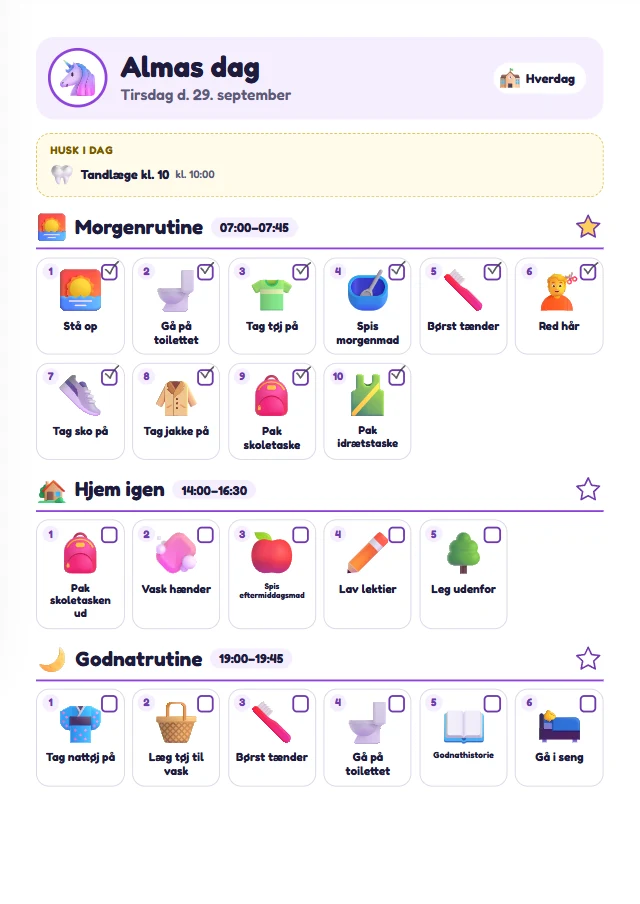
Not every situation is suited to a screen. That is why you can print today’s plan or the whole week’s plan with the same pictograms, colours and font that the child knows from the app – for the fridge, for grandparents or for school and nursery. The child ticks off with a pencil.
When the child meets the same pictures and the same structure at home and away, the plan is easier to recognise and use. And some children simply do best without a screen.
The paper has no medals either. In the Playful and Calm styles, there is a star by each routine that the child can colour in when the routine is complete – a quiet celebration that the child does themselves.
 Settings – and when they help
Here are the most important settings, and when they can help. They are chosen for each child, and you can always change them again. We are continuously working to add more knowledge to each setting.
Structure and overview
Style
Playful, Young, Grown-up or Calm. The style is a starting point for text, display, celebration and sound – everything can be fine-tuned afterwards.
View
Cards give big pictures for the youngest children. List gives an overview of many tasks. One at a time helps children who are overwhelmed by a whole list.
Show order
Numbers the tasks and shows the next one. Turn it off when the child benefits from choosing for themselves what to do first.
Show text
Text under the pictures supports the child who is learning to read. Turn it off for the youngest children, who only use pictures.
Read aloud
The app reads the tasks aloud at three speeds. The slow speed gives more time to understand.
Pictograms and photos
Colourful emojis, drawn motifs, educational AAC symbols or your own photos. Choose what the child recognises most easily.
Text
Five fonts, including the easy-to-read Atkinson Hyperlegible, where the letters are hard to confuse.
Keep the screen on
The screen does not turn off in the middle of a routine, so the child does not lose sight of the plan.
Motivation
Celebration
Big party, small party or none. Use more celebration when a new habit is getting started, and turn it down when it has settled in.
Sounds
Happy, soft or retro sounds – or none. Soft sounds suit children who are sensitive to sound.
Medals
Turned off until you choose them. Read about the pros and cons under Rewards.
Everyday life
Follow-up tasks
A little thing that is easy to forget afterwards, for example “Hang up the towel” after a bath. The app asks just when the child has ticked off the task.
Extra task today
Something special for one day, without changing the routine. The child can see it in the plan instead of being surprised.
Remember today
Reminders are shown at the top of the right day, so the child can prepare for what is different.
Week plan and special days
One plan for weekdays, another for the weekend – and another plan or a day off when it is the holidays.
The day’s or week’s plan on paper with the same pictograms and tick boxes – for the fridge, school or grandparents.

The professional basis behind Ollie
Ollie was developed together with Lærke, who is a cand.psych. and has several years of experience from PPR (Educational Psychological Counselling). The choices in the app – for example that medals are optional – have been made with that professional knowledge behind them and with the research on this page.
Ollie is a tool for everyday life and does not replace professional help. If you are worried about your child's wellbeing or development, talk to your doctor, the health visitor, your child's nursery or school, or PPR in your municipality.
Do you have questions, experiences or ideas about what we should write more about? Write to us at [email protected].
Would you like to try? The setup guide sets up the child’s first day plan in five minutes – and asks whether the child should have medals.
Get started – freeSources
- Steinbrenner, J. R., Hume, K., Odom, S. L. m.fl. (2020). Evidence-Based Practices for Children, Youth, and Young Adults with Autism. FPG Child Development Institute, University of North Carolina. fpg.unc.edu
- Knight, V., Sartini, E. & Spriggs, A. D. (2015). Evaluating visual activity schedules as evidence-based practice for individuals with autism spectrum disorders. Journal of Autism and Developmental Disorders, 45(1), 157–178. doi.org/10.1007/s10803-014-2201-z
- Lequia, J., Machalicek, W. & Rispoli, M. J. (2012). Effects of activity schedules on challenging behavior exhibited in children with autism spectrum disorders: A systematic review. Research in Autism Spectrum Disorders, 6(1), 480–492. doi.org/10.1016/j.rasd.2011.07.008
- Dettmer, S., Simpson, R. L., Myles, B. S. & Ganz, J. B. (2000). The use of visual supports to facilitate transitions of students with autism. Focus on Autism and Other Developmental Disabilities, 15(3), 163–169. doi.org/10.1177/108835760001500307
- Mesibov, G. B., Shea, V. & Schopler, E. (2004). The TEACCH Approach to Autism Spectrum Disorders. Springer. doi.org/10.1007/978-0-306-48647-0
- Boulter, C., Freeston, M., South, M. & Rodgers, J. (2014). Intolerance of uncertainty as a framework for understanding anxiety in children and adolescents with autism spectrum disorders. Journal of Autism and Developmental Disorders, 44(6), 1391–1402. doi.org/10.1007/s10803-013-2001-x
- Fiese, B. H., Tomcho, T. J., Douglas, M., Josephs, K., Poltrock, S. & Baker, T. (2002). A review of 50 years of research on naturally occurring family routines and rituals: Cause for celebration? Journal of Family Psychology, 16(4), 381–390. doi.org/10.1037/0893-3200.16.4.381
- Mirenda, P. & Locke, P. A. (1989). A comparison of symbol transparency in nonspeaking persons with intellectual disabilities. Journal of Speech and Hearing Disorders, 54(2), 131–140. doi.org/10.1044/jshd.5402.131
- Diamond, A. (2013). Executive functions. Annual Review of Psychology, 64, 135–168. doi.org/10.1146/annurev-psych-113011-143750
- Barkley, R. A. (1997). Behavioral inhibition, sustained attention, and executive functions: Constructing a unifying theory of ADHD. Psychological Bulletin, 121(1), 65–94. doi.org/10.1037/0033-2909.121.1.65
- Lepper, M. R., Greene, D. & Nisbett, R. E. (1973). Undermining children's intrinsic interest with extrinsic reward: A test of the “overjustification” hypothesis. Journal of Personality and Social Psychology, 28(1), 129–137. doi.org/10.1037/h0035519
- Deci, E. L., Koestner, R. & Ryan, R. M. (1999). A meta-analytic review of experiments examining the effects of extrinsic rewards on intrinsic motivation. Psychological Bulletin, 125(6), 627–668. doi.org/10.1037/0033-2909.125.6.627
- Frey, B. S. & Jegen, R. (2001). Motivation crowding theory. Journal of Economic Surveys, 15(5), 589–611. doi.org/10.1111/1467-6419.00150
- Cameron, J. & Pierce, W. D. (1994). Reinforcement, reward, and intrinsic motivation: A meta-analysis. Review of Educational Research, 64(3), 363–423. doi.org/10.3102/00346543064003363
- Ryan, R. M. & Deci, E. L. (2000). Self-determination theory and the facilitation of intrinsic motivation, social development, and well-being. American Psychologist, 55(1), 68–78. doi.org/10.1037/0003-066X.55.1.68
- Henderlong, J. & Lepper, M. R. (2002). The effects of praise on children's intrinsic motivation: A review and synthesis. Psychological Bulletin, 128(5), 774–795. doi.org/10.1037/0033-2909.128.5.774
- Grolnick, W. S. & Ryan, R. M. (1989). Parent styles associated with children's self-regulation and competence in school. Journal of Educational Psychology, 81(2), 143–154. doi.org/10.1037/0022-0663.81.2.143
- Joussemet, M., Landry, R. & Koestner, R. (2008). A self-determination theory perspective on parenting. Canadian Psychology, 49(3), 194–200. doi.org/10.1037/a0012754
- Patall, E. A., Cooper, H. & Robinson, J. C. (2008). The effects of choice on intrinsic motivation and related outcomes: A meta-analysis of research findings. Psychological Bulletin, 134(2), 270–300. doi.org/10.1037/0033-2909.134.2.270
- McClannahan, L. E. & Krantz, P. J. (2010). Activity Schedules for Children with Autism: Teaching Independent Behavior (2. udg.). Woodbine House.
- Ben-Sasson, A., Hen, L., Fluss, R., Cermak, S. A., Engel-Yeger, B. & Gal, E. (2009). A meta-analysis of sensory modulation symptoms in individuals with autism spectrum disorders. Journal of Autism and Developmental Disorders, 39(1), 1–11. doi.org/10.1007/s10803-008-0593-3
- Wood, D., Bruner, J. S. & Ross, G. (1976). The role of tutoring in problem solving. Journal of Child Psychology and Psychiatry, 17(2), 89–100. doi.org/10.1111/j.1469-7610.1976.tb00381.x